How to Remove Road Salt Stains from a Toronto Driveway Without Damaging Concrete
Why road salt leaves white efflorescence on Toronto driveways, why cold water fails, and how hot-water power washing lifts chloride without etching concrete.
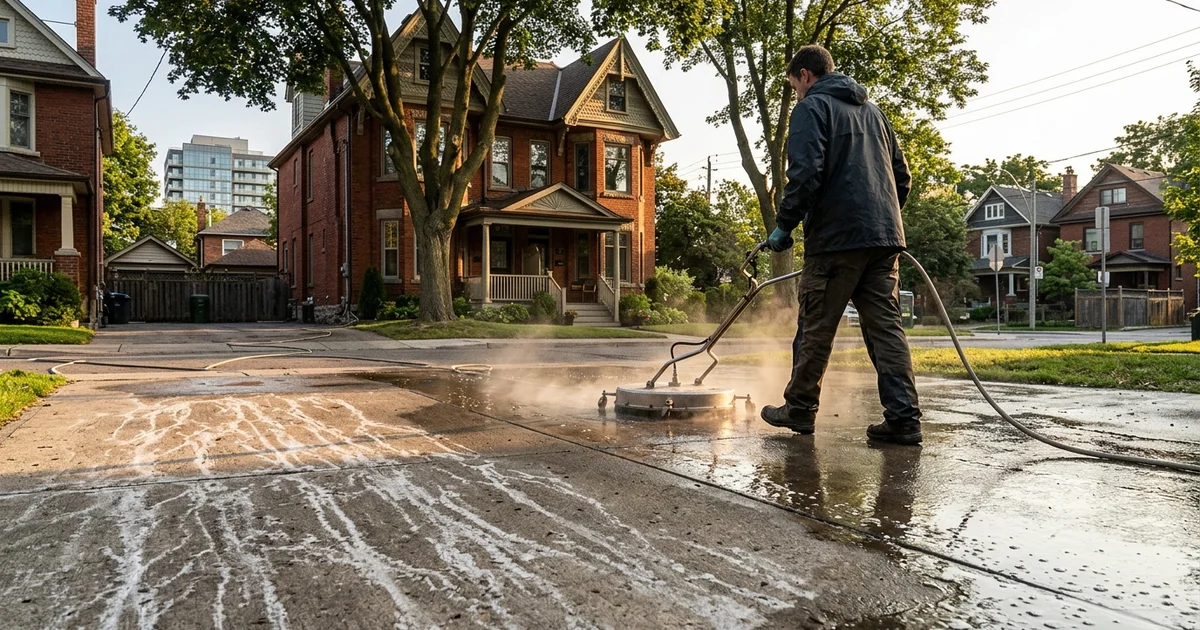
Every spring, Toronto driveways show the same pattern: white lines along the edges, a chalky haze in the tire tracks and rough patches where the surface has started to flake. That is road salt at work. It can be removed without damaging the concrete, but not with a garden hose or a cold rental machine.
Why Road Salt Stains Toronto Driveways
Toronto uses a lot of road salt, and your driveway gets its share from tires, boots and the plow. When snow melts, salty water soaks into the pores of the concrete. As it dries, the water evaporates and leaves salt behind, along with minerals drawn up from inside the concrete. That white crust is called efflorescence.
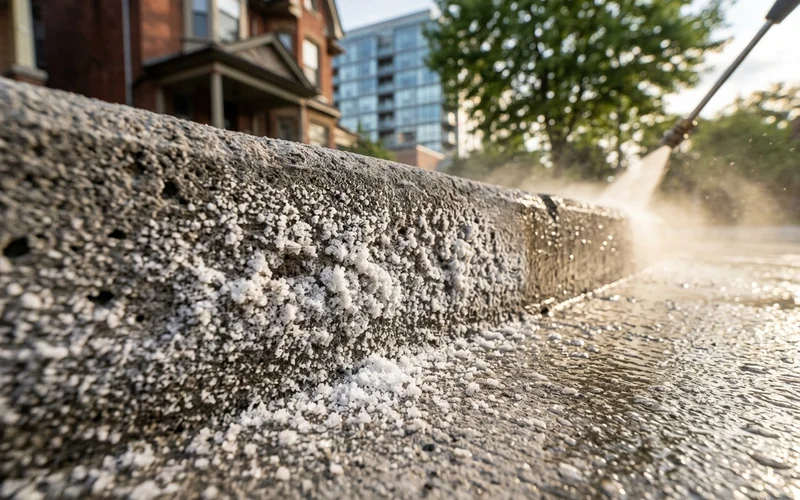
The deeper problem is chloride. It does not just sit on top. It works into the concrete and makes freeze-thaw damage worse. Toronto sees dozens of freeze-thaw cycles each winter. Water in the pores freezes, expands and pops off the top layer of the surface. That flaking is called spalling, and once it starts it keeps going.
Why Cold Water Cannot Lift Set Salt
A cold pressure washer can rinse loose salt off the surface, which is why the driveway looks better for a day. But the salt inside the pores stays put, and the white haze returns as the concrete dries. Turning up the pressure to compensate is how people etch stripes into their driveways.
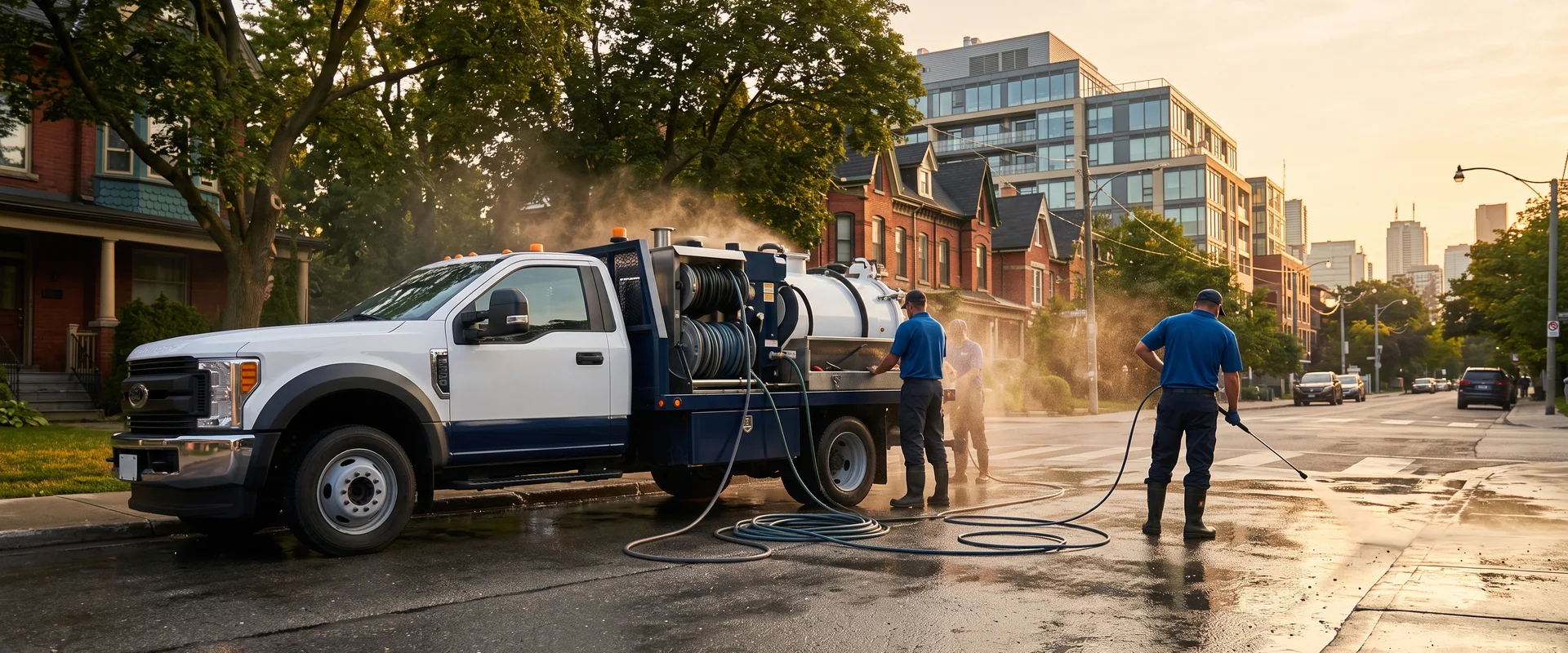
Hot water is the difference. Our 200F power washer dissolves salt crystals and flushes them out of the pores. Combined with a rotary surface cleaner, it lifts the deposit evenly across the whole surface.
What not to do
Do not use a 0-degree tip, do not hold a wand close to the concrete, and do not scrub with muriatic acid unless you know exactly what you are doing. All three can permanently damage the surface.
Surface Cleaner vs Wand: Avoiding Etch Lines
A pressure wand swept back and forth leaves overlapping arcs, and each arc cleans slightly differently. On concrete that shows up as zebra stripes that are very hard to fix.
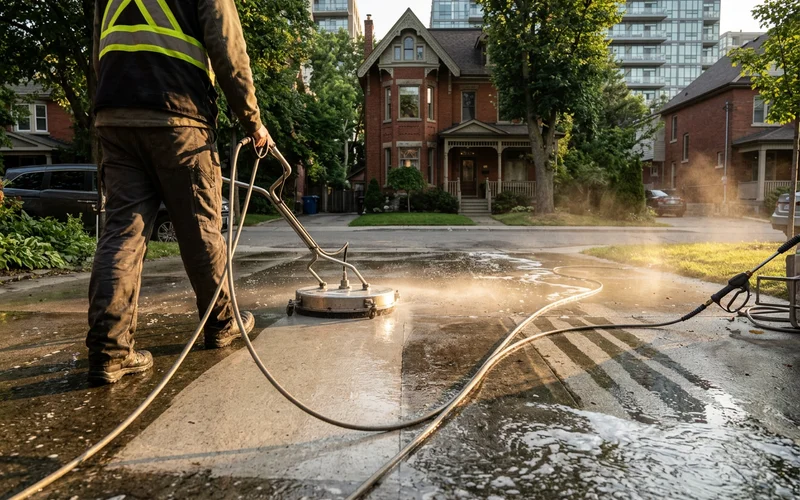
A rotary surface cleaner holds two spinning nozzles at a fixed height inside a hood. Every square foot gets the same treatment, so the finish is uniform. We still use a wand for edges and steps, but at a controlled distance with a 25 or 40-degree tip.
| Method | Removes set salt | Risk of etching | Finish |
|---|---|---|---|
| Garden hose | No | None | Salt returns |
| Cold rental machine, wand | Partly | High | Often striped |
| Hot water + surface cleaner | Yes | Low | Even |
Step by Step: How We Clean a Salt-Stained Driveway
- Pre-rinse to remove loose grit.
- Pre-treat heavy efflorescence and any oil spots.
- Hot-water wash with a rotary surface cleaner across the full driveway.
- Detail edges, the apron and steps with a controlled wand.
- Final rinse so dissolved salt does not redeposit.
- Optional sealing once the concrete is dry.
A 1-car driveway takes about an hour and runs $150-$250. A 2-car driveway runs $250-$400. See full details on our driveway cleaning page.
Sealing After Washing
A penetrating concrete sealer reduces how much salty water soaks in next winter. It must go on clean, dry concrete, which is why we offer it as an add-on right after washing. Sealing will not stop all salt marks, but it makes next spring’s clean faster and slows spalling.
What About Interlock Driveways?
Interlock pavers collect salt too, but their joints add a complication. Cleaning must avoid blasting out the joint sand, and the sand often needs replacing after winter. That is a different job, covered in our guide to interlock polymeric sand, pressure specs and resealing and on our interlocking stone cleaning service page.
If you are weighing hot water against other methods for the rest of the house, read power washing vs pressure washing vs soft washing, or see our main pressure washing service.
Power Pressure Washing Toronto clears salt-stained driveways across the GTA, including Willowdale, Hoggs Hollow and Don Mills through our North York crew.
Ready to get the salt lines off for good? Request a free written quote with a photo of your driveway and we will price it per surface.